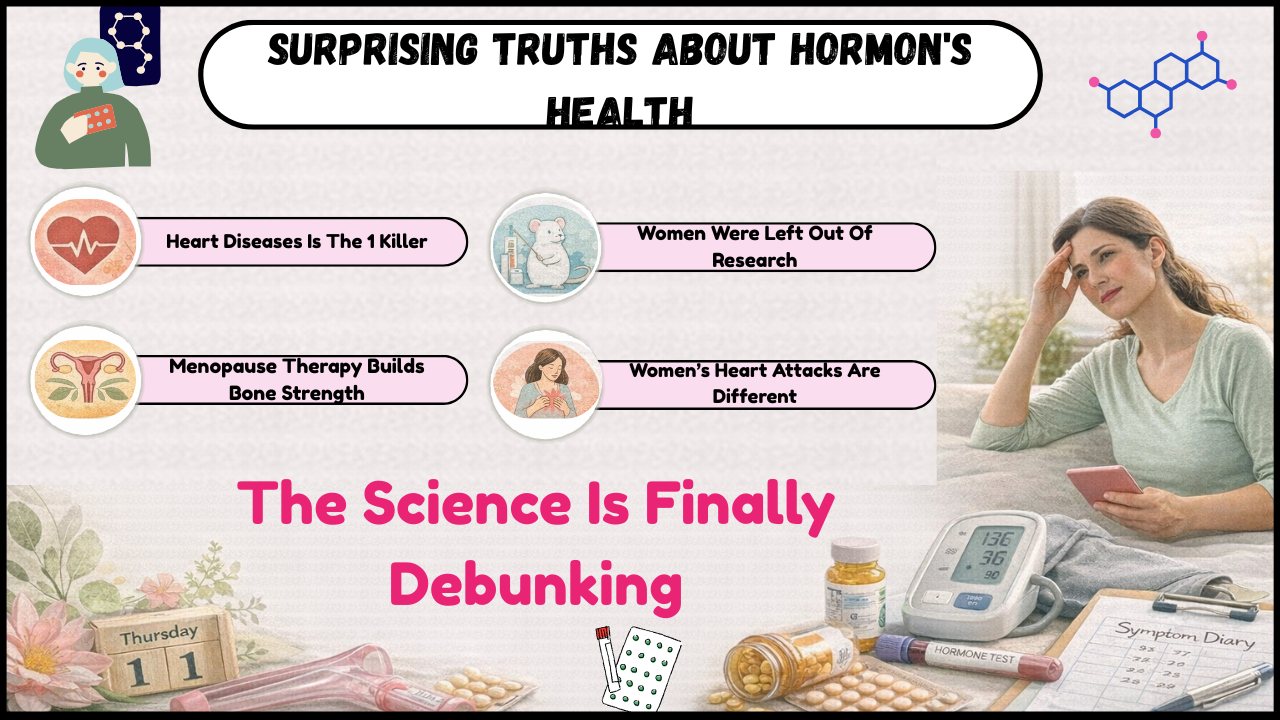
Breaking Myths Around Women’s Health
The gender health gap is not a medical accident; it is an inheritance. For centuries, the female body has been viewed through a lens of “otherness,” treated as a deviation from the male biological default. Even in 2026, as we move toward personalized medicine, the remnants of 19th-century bias continue to shape how women are diagnosed, treated, and believed. We live in a world where women are conditioned to fear the well-known threat of cancer yet remain dangerously unaware of the silent predator actually claiming their lives.
To close the health gap, we must dismantle outdated assumptions and replace them with clinical clarity.
Here are six truths that modern science—and women themselves—are finally bringing to light.
The Deadliest Misconception: Heart Disease vs. Breast Cancer
There is a profound disconnect between the medical fears women carry and the actual statistics surrounding their survival. The Breast Cancer Myths Scale illustrates how the cultural fear of cancer often leads to dangerous complacency toward other life-threatening conditions.
While breast cancer is a valid concern, it is not the leading killer of women. In the United States, cardiovascular disease claims the lives of 161,698 women every year, compared to 40,861 deaths from breast cancer. Despite heart disease killing nearly twice as many women as all cancers combined, women remain less likely to undergo cardiovascular screenings.
This complacency has consequences: according to the Scripps Women’s Heart Center, women aged 45 and younger are more likely than men to die within a year of their first heart attack.
The “Male Default” in Research: Beyond the Male Mouse
Historically, the male body was the default model for scientific research. Women were excluded from clinical trials for decades under the guise of “protecting fertility” or avoiding the “variable noise” of menstrual cycles.
In animal research, the bias was even more pronounced—male mice were overwhelmingly used because scientists incorrectly assumed including females would require doubling the sample size and reduce statistical clarity. This justification has since been debunked.
The consequence? A medical system built on a one-size-fits-all standard that actually fits men.
Because women often have slower gastric transit times and higher body fat composition, they metabolize medications differently. With “standard” doses of cardiovascular drugs, antidepressants, or anti-seizure medications, women frequently experience higher blood concentrations and slower drug elimination. This leads to significantly higher rates of adverse drug reactions—nearly double that of men.
Heart Attacks Don’t Always “Hurt”: The Symptom Gap
The Hollywood image of a man clutching his chest in agonizing pain has shaped public understanding of heart attacks. But for women, the symptoms are often quieter and more subtle.
Nearly half of all women who suffer heart attacks never experience the classic, crushing chest pain. Instead, symptoms may include:
intense shortness of breath (“air hunger”)
nausea
jaw or back pain
unusual, persistent fatigue
These symptoms can appear a month before the event and are often misdiagnosed as flu, stress, or digestive issues—by patients and providers alike. This symptom gap leads to delayed treatment and a higher risk of death.
The Ghost of “Hysteria”: Why Women’s Pain Is Still Misdiagnosed
The dismissal of women’s pain is deeply rooted in a medical history that labeled female suffering as “hysteria.” Sir William Osler, the so-called “father of modern medicine,” famously dismissed women’s cardiac pain as “pseudo-angina,” attributing symptoms to nervous temperament rather than physiological distress. He insisted that “these patients do not die.”
He was wrong.
Today, echoes of this bias persist in the 84% of women who report feeling unheard by their healthcare providers. Women remain less likely than men to receive adequate pain management, and conditions such as endometriosis or cardiac disease are frequently misattributed to anxiety. This leads to years-long delays in diagnosis—sometimes with life-altering consequences.
MHT: Stronger Bones and an Undeserved Reputation
Menopause Hormone Therapy (MHT) has long carried a reputation shaped by outdated, oversimplified interpretations of early research. But modern data paints a far more nuanced—and encouraging—picture.
For women under 60 or within 10 years of menopause, MHT offers significant benefits. Beyond easing vasomotor symptoms such as hot flashes and night sweats, MHT has a powerful effect on long-term bone health. Women who use MHT for just three to five years maintain significantly stronger bones even 15 years later, dramatically reducing osteoporosis and fracture risk.
While concerns about breast cancer persist, the increased risk is comparable to drinking one glass of wine per day and considerably lower than risks associated with obesity or inactivity. For those unable to use hormones, non-hormonal alternatives such as Fezolinetant or gabapentin now provide evidence-based relief.
Alzheimer’s and PCOS: Biology Beyond Longevity
We are learning that women’s increased vulnerability to certain conditions is rooted in biology—not just longer life expectancy.
Alzheimer’s Disease: Two-thirds of Americans with Alzheimer’s are women. Research into "extracellular vesicles," the microscopic carriers of cellular material, suggests that women may have distinct disease pathways compared to men.
PCOS: Polycystic Ovarian Syndrome affects 1 in 10 women, yet nearly 70% remain undiagnosed. Using the Rotterdam Criteria—hyperandrogenism, ovulatory dysfunction, and/or polycystic ovaries—accurate diagnosis is critical, as PCOS increases the risk of infertility, Type II diabetes, and cardiovascular disease.
Building a Better Standard of Care
True advocacy is the bridge to a more equitable healthcare system. The female body is not a variation—it is its own biological blueprint. Women can empower themselves by keeping detailed symptom diaries, noting patterns and triggers, bringing written questions to appointments, and anchoring their experiences in clinical language.
If medicine has long been built on a male default, imagine the possibilities when we finally begin listening, researching, and treating women based on the unique signals of their bodies.
GEWO Health
At GEWO Health, we believe women deserve care that listens, learns, and evolves—and we’re here to help you navigate your health with clarity, authority, and unwavering support at every stage of life