Mental Health
Brain Stroke: Acting Within the "Golden Window" Can Save a Life
A stroke can happen suddenly, but many cases are preventable with healthy habits and early action. Managing blood pressure, blood sugar, cholesterol, staying active, eating a balanced diet, and avoiding tobacco can significantly lower your risk. Learn the warning signs using the B.E.F.A.S.T. method and act immediately if symptoms appear. Quick treatment can save brain function, reduce disability, and even save lives. Your brain health starts with prevention.
Every 40 seconds, an Indian suffers a brain stroke and every 4 minutes, someone in our country loses their life to it. Once considered an illness of old age, stroke is rising dramatically among young and middle-aged Indians due to rapid lifestyle shifts, metabolic risks and high stress.
A stroke is a medical emergency that occurs when the blood supply to part of your brain is cut off or reduced, preventing brain tissue from getting oxygen and nutrients. Within minutes, brain cells begin to die. However, a stroke is highly treatable if you reach the right destination in time. Knowing how to spot a stroke and exactly where to go can mean the difference between full recovery and permanent disability.
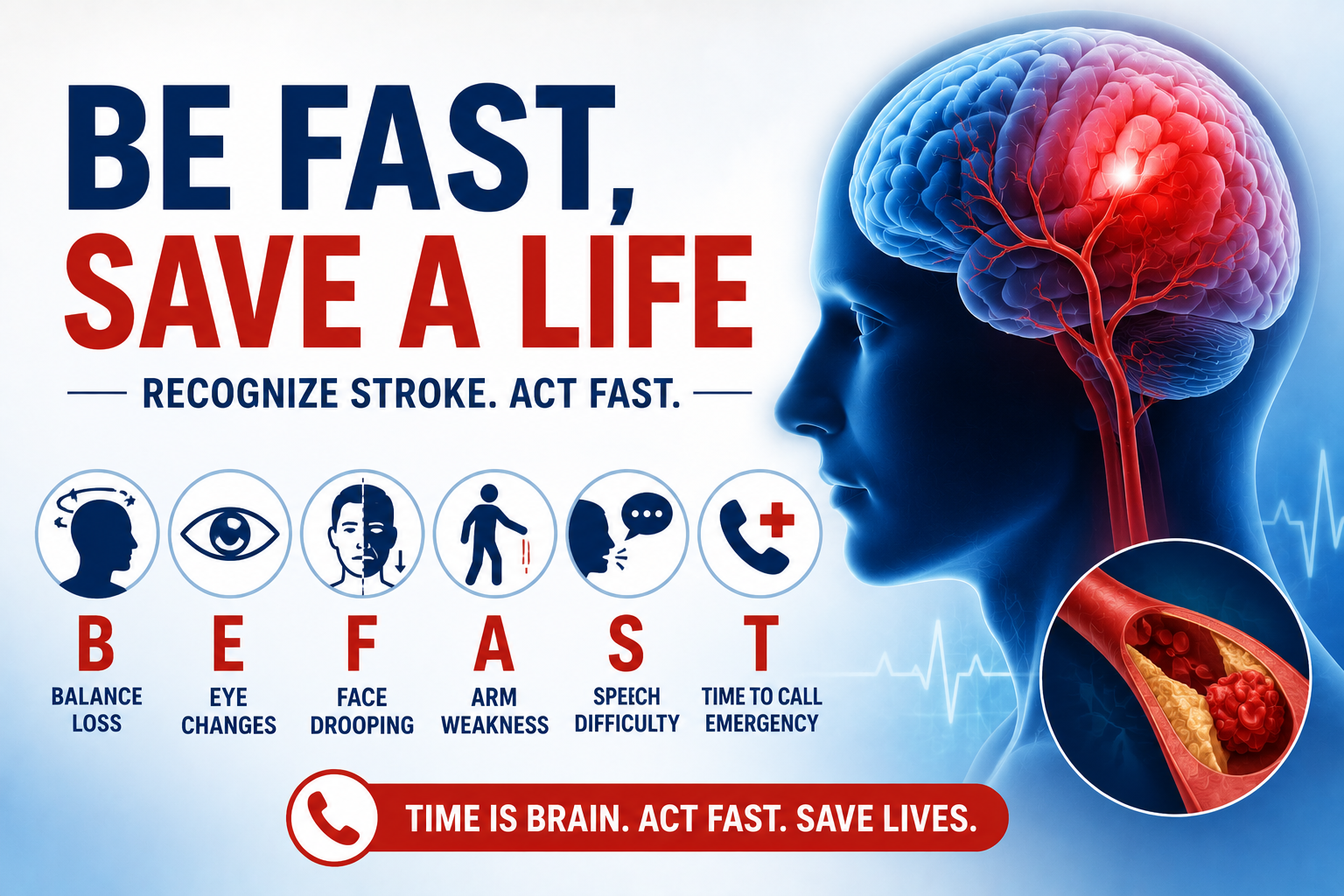
Spotting a Stroke Instantly: Think B.E.F.A.S.T.
When a stroke hits, there is no time to "wait and see."
You must act immediately if you notice any of these sudden warning signs.
The global medical community uses the B.E.F.A.S.T. acronym to help ordinary citizens memorize the
signs:
● B – Balance: Is the person suddenly struggling to stand or walk? Are they experiencing dizziness
or a loss of coordination?
● E – Eyes: Is there a sudden blurriness, double vision, or complete loss of sight in one or both
eyes?
● F – Face Drooping: Ask the person to smile. Does one side of the face sag or feel numb?
● A – Arm Weakness: Ask the person to raise both arms. Does one arm drift downward, or feel
completely numb and heavy?
● S – Speech Difficulty: Is their speech slurred or garbled? Can they repeat a simple sentence, or
are they struggling to understand words?
● T – Time to Call Emergency: If any of these signs are present, even if they go away-note the
exact time the symptoms started and call emergency services immediately.
What to Do: The Critical 4-to-6-Hour Window:
In stroke care, neurologists have a golden rule: "Time is brain."
Every single minute a stroke goes untreated, the brain loses roughly 1.9 million neurons.
Recent clinical guidelines emphasize a crucial timeline: a stroke patient must ideally be transferred to a specialized Stroke Unit within 4 to 6 hours of their first symptom. Within this tight window, doctors can administer advanced "clot-busting" intravenous thrombolysis medications (like tenecteplase or alteplase) to dissolve the blockage. For larger blood vessel clots, advanced physical clot-removal procedures (mechanical thrombectomy) can safely restore blood flow up to 6 hours and in specialized cases with advanced imaging, up to 24 hours. However, the sooner the treatment begins, the higher the chances of an absolute cure.
The Emergency Number in India: If you suspect someone is having a stroke, do not waste time calling a family doctor or trying to drive them yourself through heavy traffic in a regular vehicle.
📞 Dial 102 or 108 immediately to call a centralized government ambulance service in India, or call your trusted local hospital's direct cardiac/stroke emergency ambulance network.
How to Recognize a "Stroke-Ready" Hospital?
A common and tragic mistake in India is taking a stroke patient to the nearest neighborhood clinic or a small nursing home. Most general hospitals do not have the infrastructure to treat an acute stroke. Because of that, valuable hours are often lost transferring patients between facilities.
When calling an ambulance or selecting a hospital, you must ensure it is a Stroke-Ready Hospital or has a dedicated Stroke Unit. A hospital qualifies if it features the following infrastructure 24/7:
1. In-House, Round-the-Clock Diagnostics: It must have a functioning CT scan or MRI machine available 24/7.Doctors cannot treat a stroke without a scan to verify whether it is caused by a clot (ischemic) or a brain bleed (hemorrhagic).
2. A Specialized Stroke Team: A neurologist, emergency physician and radiologist must be physically present or on active, immediate call.
3. A Dedicated Stroke Unit (ICU/Semi-ICU): This is a specialized ward staffed by nurses and therapists trained specifically in monitoring stroke progression, swallowing safety, and early rehabilitation.
4. Advanced Accreditation: Look for premier hospitals certified by the National Accreditation Board for Hospitals (NABH) in joint collaboration with the World Stroke Organization (WSO), or the Indian Stroke Association (ISA).
Causes and Risk Factors
A stroke happens via two primary mechanisms: an Ischemic Stroke occurs when a clot blocks blood flow to the brain (accounting for over 80% of cases), while a Hemorrhagic Stroke occurs when a weakened blood vessel bursts open and bleeds into the brain. While genetic factors play a minor role, the massive surge of stroke cases in India is driven by highly
manageable conditions:
● Hypertension (High Blood Pressure):The single biggest culprit, uncontrolled blood pressure
puts constant, destructive stress on arterial walls.
● Diabetes and Metabolic Syndrome: High blood sugar damages blood vessels over time,
making clot formation much more likely.
● High Cholesterol: Excess LDL ("bad cholesterol") builds up as fatty plaque inside brain arteries,
narrowing the pathways.
● Lifestyle Triggers: High tobacco consumption (both smoking and chewing gutka), heavy alcohol
intake, physical inactivity, and diets packed with trans fats, heavy salt, and refined carbohydrates.
● Cardiac Issues: Heart conditions like Atrial Fibrillation (irregular heartbeats) can cause blood
clots to form in the heart and travel directly up into the brain.
Prevention Tips:
Up to 90% of all strokes are completely preventable through structured daily habits. You can take control of your vascular health by implementing these preventive adjustments:
● Monitor Your Numbers: Check your blood pressure and blood sugar regularly. Keep your blood
pressure strictly below 140/90 mmHg or 130/80 mmHg if you are diabetic or middle age).
● Modify Your Traditional Diet: Reduce your daily salt intake to under 5 grams (about one
teaspoon) to protect your arteries. Cut down on deep-fried street foods and saturated fats.
Instead, load your plate with potassium-rich green leafy vegetables, lentils, whole grains and
fresh fruits.
● Commit to Consistent Movement: Dedicate at least 30 minutes to moderate physical activity,
such as brisk walking, cycling or swimming 5 days a week.
● Eradicate Tobacco: Completely stop smoking cigarettes and chewing tobacco. Tobacco
chemicals accelerate plaque buildup in your arteries almost instantly.
Treatment Awareness:
Modern medicine treats strokes with extreme precision. If you arrive at a stroke unit within the golden window, the standard care pathway involves:
● Thrombolysis: The immediate injection of highly effective clot-dissolving medications.
● Mechanical Thrombectomy: A minimally invasive procedure where an interventional neurologist inserts a tiny catheter through an artery in the groin or arm all the way up to the brain to physically pull the clot out.
● Neuro-Rehabilitation: True recovery extends beyond the emergency room. Dedicated stroke units introduce physiotherapy, occupational therapy, and speech therapy within the first 24 to 48 hours of stabilization to rewire brain pathways and restore lost motor skills.
GEWO Health Message:
At GEWO, we believe that health awareness is your first line of defense against life-threatening emergencies. A stroke does not give a second chance, but a well-informed community can save lives. Memorize B.E.F.A.S.T., share this knowledge with your parents, neighbors, and coworkers, and identify your nearest Stroke-Ready Hospital today. Let us work together to build a healthier, stroke-aware India.
Medical Disclaimer
This article is for informational and educational purposes only and should not be treated as professional medical advice, diagnosis, or treatment. Always consult a qualified neurologist or healthcare provider regarding any chronic medical conditions or preventive health plans. If you suspect an active stroke emergency, call India's emergency services (102/108) or proceed to the nearest stroke-ready hospital immediately.