Patient Education
Gas or heart attack? How to tell, and act fast
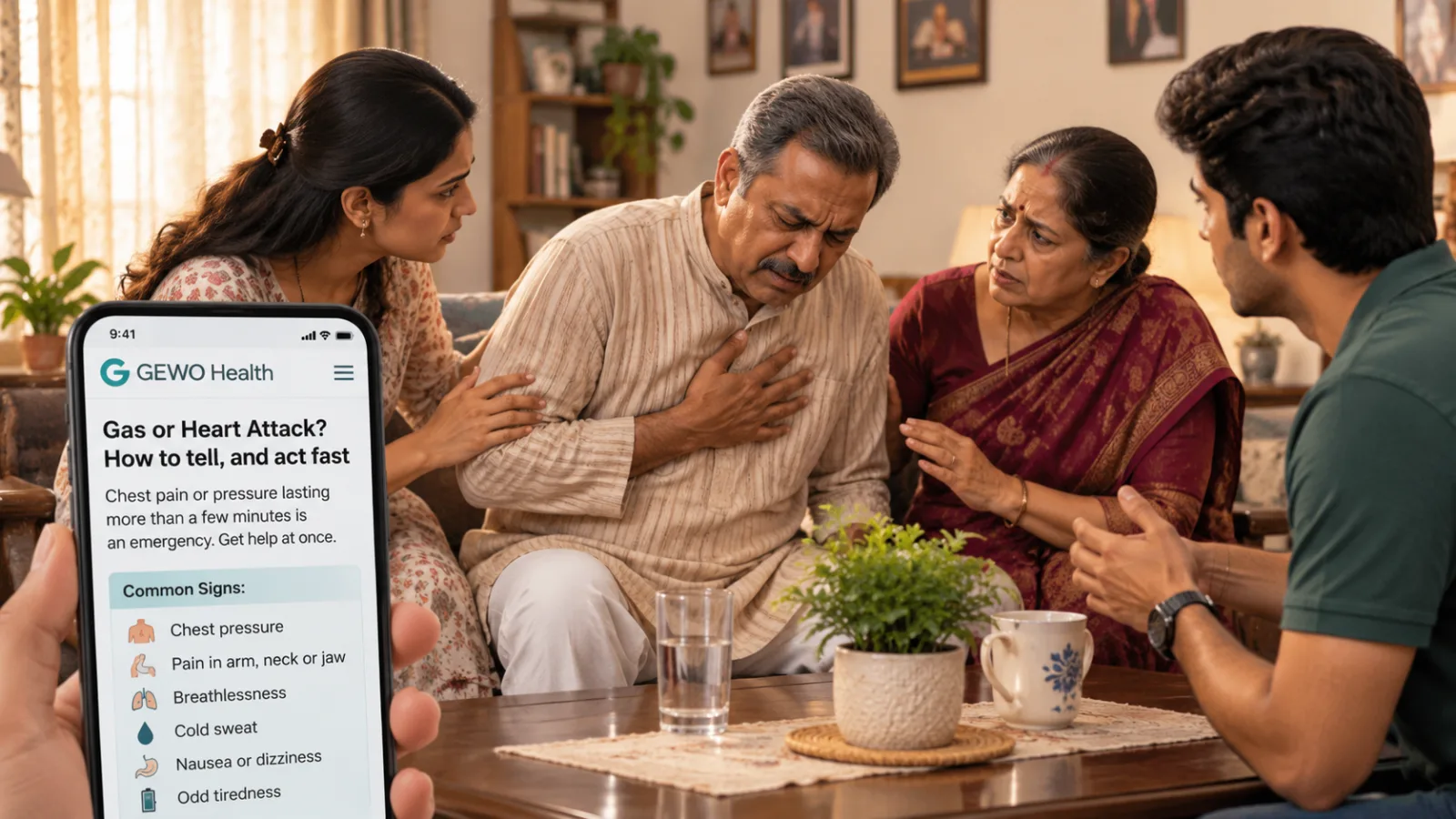
A heart attack happens when blood stops reaching part of the heart. It can feel like "gas" or acidity. It can strike in your 30s and 40s. Chest pain or pressure lasting more than a few minutes is an emergency. Get help at once.
Written by: GEWO Health Team · Reviewed by: Dr. Aadhya Nigam · Last reviewed: 17-11-26
What: A blocked heart artery starves part of the heart of blood.
How common: In a big Indian study, people took a median of 6 hours to reach hospital.
See a doctor: Now, for chest pain or pressure that does not go away.
What helps: Fast hospital care to open the artery, then long-term care.
GET WELL: spot it in minutes
1. Is it just gas, or is it my heart?
You cannot be sure at home. So treat it as the heart until a doctor says no. A heart attack can feel like a burning chest, fullness or bloating.
A heart attack happens when a heart artery gets blocked. The heart muscle beyond it starts to die. The faster blood flow comes back, the more muscle is saved.
One Indian study followed over 20,000 people. The median wait was 6 hours. That is far too long. In a North East India study, most delays happened because people missed the signs.
2. What signs should we look for?
Signs can be strong or mild. They can come and go for hours.
Sign | What you may notice |
|---|---|
Chest pressure | Heaviness, squeezing or burning in the middle of the chest. |
Spreading pain | Pain in the arm, back, neck, jaw or upper belly. |
Breathlessness | Short of breath, even at rest. |
Cold sweat | Heavy sweating with no clear reason. |
Sick or dizzy | Nausea, vomiting or feeling faint. |
Odd tiredness | Very tired for days, more common in women. |
Some heart attacks have mild or no signs. This is more common in older people and in people with diabetes.
3. Why does it happen? (It is not bad luck)
Most heart attacks come from a fatty build-up inside a heart artery. A clot forms on it and blocks blood flow.
Tobacco: Smoking and chewing tobacco are big causes. In a North India study, two in three young patients used tobacco.
Sitting too much: Many young patients did little exercise.
High BP, sugar and cholesterol: These damage arteries over years.
Family history: A parent or sibling with early heart disease raises your risk.
South Asians often get a first heart attack at a younger age. In one big study, this was mainly due to risk factors starting young. That means much of the risk can be changed.
4. What do Indian families often believe?
What people say | What is true |
|---|---|
"It is only gas. Lie down for a while." | A heart attack can feel like acidity. Get checked now. |
"He is only 40. It cannot be his heart." | In one North India study, a third of patients were under 50. |
"No chest pain, so no heart attack." | Signs can be mild or missing, mainly in women and diabetics. |
"Let us wait and see if it passes." | Every minute counts. Waiting lets more heart muscle die. |
5. When should we see a doctor?
Watch at home if: You have a short, sharp twinge that goes with a change of position. You have no other signs.
Book a doctor if: You get chest discomfort on walking or climbing stairs that settles with rest. This can be a warning sign. Book a doctor
Go now if: Chest pain, pressure or burning lasts more than a few minutes. Or it spreads to the arm, jaw or back. Go now for breathlessness, cold sweat or fainting. Call your local emergency number or go to the nearest hospital now. Find your emergency number
At the hospital: The team does an ECG, a quick heart tracing. A blood test looks for heart muscle damage. Then they work to open the blocked artery fast.
LIVE WELL: act fast, heal well
6. What can we do right now?
Act first. Think later.
Call for help: Call your local emergency number. Do not wait to see if it passes.
Do not drive yourself: An ambulance is safest. The team can start care on the way.
Rest: Sit on the floor or a chair. Keep knees bent and the back supported.
No home remedies: Do not lose time on hot water, massage or antacids. Ask the emergency team before giving any tablet.
If they collapse: If the person stops breathing, start CPR if you know how.
In a Punjab study, people who knew the heart signs reached care sooner. Talk about these signs at home.
7. What happens in the hospital?
Hospital teams open the blocked artery. This may be with a small balloon and a tiny mesh tube (stent). Some people need bypass surgery. Medicines also help clear the block and improve blood flow.
After that, daily medicines, no tobacco, good food and slow, guided exercise protect the heart.
What can we start this week?
Start with any three:
Learn the signs. Share this list on the family WhatsApp group.
Save the numbers. Keep your local emergency number and nearest heart hospital on the fridge.
Quit tobacco. Ask a doctor for help to stop smoking or chewing.
Get checked. Ask for a BP, sugar and cholesterol test.
Learn CPR. Find a local first-aid class for one family member.
Free checks in India: The national NCD programme checks BP and sugar in adults aged 30 and above. Ask at your nearest Ayushman Arogya Mandir.
8. Will I be okay?
Many people recover well after a heart attack, mainly with fast care. In the North India study, young patients had better survival. They also reached care earlier.
The heart needs time to heal. Steady medicines and lifestyle changes lower the chance of another one.
The good news: Fast action saves heart muscle and lives. Knowing the signs is something every family can learn tonight. After care, most people return to work, family and the things they love.
Need help? Book a doctor · Book a wellness provider
Get Well. Live Well.
Medical disclaimer: This article is for general information only. It is not a diagnosis or a substitute for advice from your own doctor. Always speak to a qualified doctor about your health or your child's health. Do not stop or start any treatment based on this article. In an emergency, do not wait for an online consultation. Call your local emergency number or go to the nearest hospital. Find emergency numbers for every country, by continent.